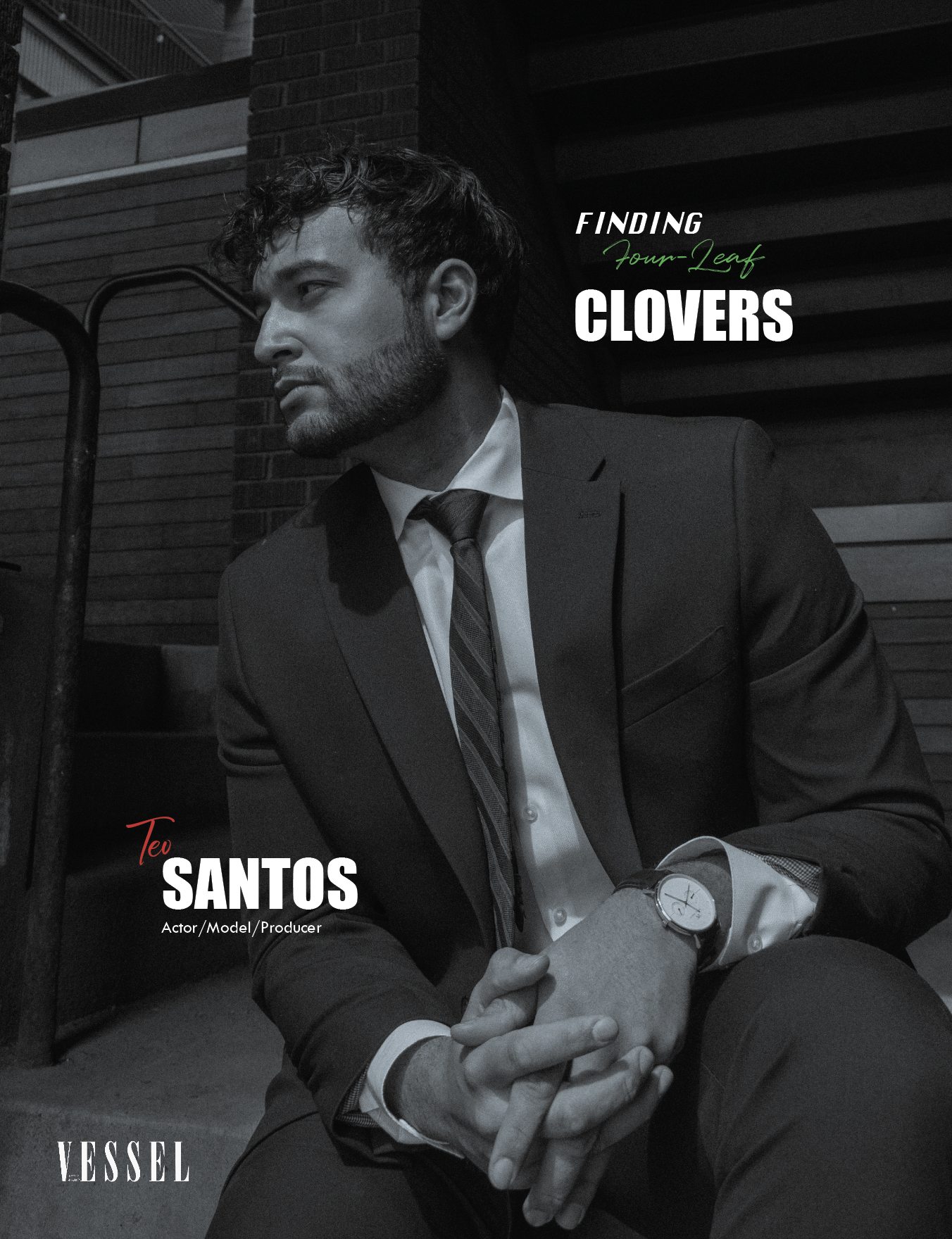
Finding Four-Leaf Clovers
Interview with Teo Santos
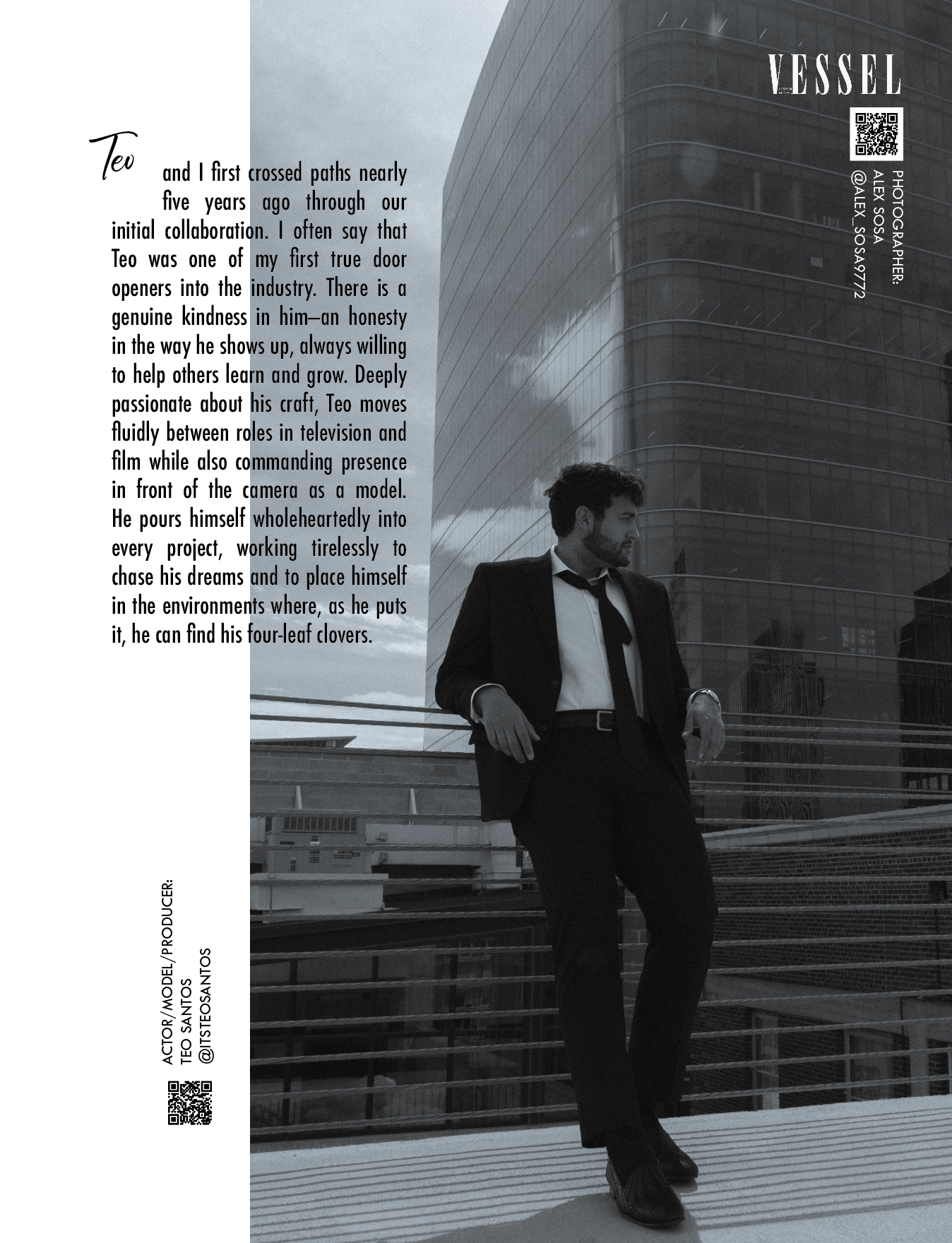
VESSEL: Hello Teo. Would you please give us a brief introduction about yourself?
Teo: I’m Teo. I’m a Brazilian actor and producer. Yeah, it’s really fun. I never imagined this would be my career. I was going to be a doctor, and now I work in entertainment—which my immigrant parents aren’t too happy about—but hey, I love it.
V: I hear you. In Asian culture, you’re expected to be a doctor or an engineer, something along those lines. I always feel very blessed that my mom has been so open in supporting my dreams. She was like, “Oh, if art is what you want to do, then do that.”
T: My parents have come around, for sure.
V: So tell us, how did you survive the last two years in this industry—with such busy schedules, traveling all over, and taking on multiple projects?
T: It’s been good. How did I survive? I have no idea. I feel like I’ve survived on no sleep, a dream, and a lot of matcha, pretty much. No, it’s been a crazy two years—in a good way. I got a new team out in LA that helped a ton in terms of getting really big auditions and going out for major projects. I auditioned for Anaconda last year with Jack Black and Paul Rudd, and I also auditioned for a project with Joaquin Phoenix about a year and a half ago. So it’s been really exciting—but also exhausting.
V: How did you get yourself to be so dedicated and intentional about going after what you want? A lot of actors out there are probably thinking, “Oh, I want this, I want that.” But what does it really take to understand that you have to put in the work—and that having the right team and agent is such a big part of it? How did you get to that point?
T: I invested a lot—not only in acting classes and becoming a better actor, but also in finding coaches online that I really trusted. They’re industry veterans who have now become mentors to me and have helped guide my career, which has been incredibly valuable.
I also say this all the time: no one is ever going to work as hard as you will or stay up as late as you will to make your dreams come true. So it’s a lot of hard work, a lot of late nights, a lot of cold emailing, and just reaching out to see what happens. I think that’s made a huge difference. At the end of the day, talent can only get you so far. You should absolutely strive to develop your talent—but hard work takes you further. And when you combine hard work with smart work, it can take you even further than that.
Finding mentors who could guide me in the right direction, putting in the time, hustling, and not being afraid of hearing “no”—that’s all a big part of it.
At one point in 2023, I was feeling frustrated with my career. It wasn’t moving as fast as I wanted. My background is in medicine—I was on track to go to medical school and make my parents proud—but then I chose this path instead. I was 25, turning 26, and I felt behind compared to people who had been doing this since they were kids. They were further ahead, more experienced, more connected. And in this industry, nepotism can definitely help. It was frustrating.
I remember venting to a friend and telling her how much I hated that it felt like success was based on luck—being in the right place at the right time. It made me feel like I had no control over my career. In a more traditional job, like at Microsoft, you can apply elsewhere or move up within a company. There’s structure. But in this industry, there’s no clear path, and that lack of control really got to me.
She said something that completely shifted my perspective. She said, “Being in the right place at the right time is like finding a four-leaf clover.” I didn’t even realize how rare they were—but apparently, they are. She told me she had found around 40 of them in her life. And the reason, she said, was because she understood the environments where they grow. She could recognize those environments, and by placing herself in them often enough, she would eventually find one.
That completely changed how I saw everything. I thought, okay—what are the right environments I need to be in to move my career forward?
So I set a goal to attend seven of the biggest film festivals last year. It was challenging, but also incredibly rewarding. I learned so much—exponentially more just by being in those spaces.
V: What would you like to see happen in the next five years?
T: I go back and forth on that question a lot. I would love to step further into producing. The films that resonate with me are the ones I want to help bring to life—and ideally, also act in. Right now, as an actor, you audition for everything. But as a producer, I’m really drawn to projects that have impact.
My whole ethos is that film can build a pipeline to empathy. In the next five years, I hope to finish the short films I have planned for this year, produce my first feature within the next two to three years, and continue growing as an actor—taking on bigger roles in both television and film. At the same time, I want to pursue excellence on the business side—making sure my team is aligned and that we’re all moving in the same direction.
V: It’s interesting in Western markets—if you land the right show, you can break out instantly. You can become huge from that one role. In Asia, it’s very different. Sometimes you have to work in television for 20 years before you’re recognized. In Hollywood, it’s still incredibly difficult to break in, but sometimes someone with raw talent lands the right role and suddenly becomes a breakout star. It really shows how much timing and opportunity matter.
And what you said about the four-leaf clover—that’s definitely going to be your title. Sometimes it really is about placing yourself in the right environments. It’s hard to always know what’s “right,” or whether you’re meeting the right people—but if you keep showing up in the right spaces, eventually the right connections happen.
T: Yeah, I completely agree. The people you surround yourself with matter so much. Being around people who lift you up and support you—it makes a huge difference. Especially in this industry, where it can feel like there aren’t always people rooting for you. Finding those people and keeping them close is really important.
V: That’s definitely the challenge—especially in bigger markets like LA or New York. A lot of times, when you try to connect with someone, there’s this underlying question of, “What do I get in return?” That’s the tricky part—finding people who are genuinely willing to help.
T: Yeah, a lot of people do want something in return. And from a business perspective, I understand that. But I also believe in an abundance mindset—that there’s enough out there for everyone. Helping someone else doesn’t take anything away from you. Being open, being vulnerable, and supporting others—I don’t think that ever works against you.
V: So, where are you headed next?
T: That’s a good question—we’ll see. I’m really excited about a short film we’re shooting in New York next month, or in May. That’s something we’ve been developing for about a year, so it’s exciting to finally bring it to life.
I also have a series in development that I helped write—something I’m really passionate about. Hopefully, we’ll shoot that this summer. Right now, I’m focused on continuing to build my work and making sure I’m ready when the right opportunity presents itself.